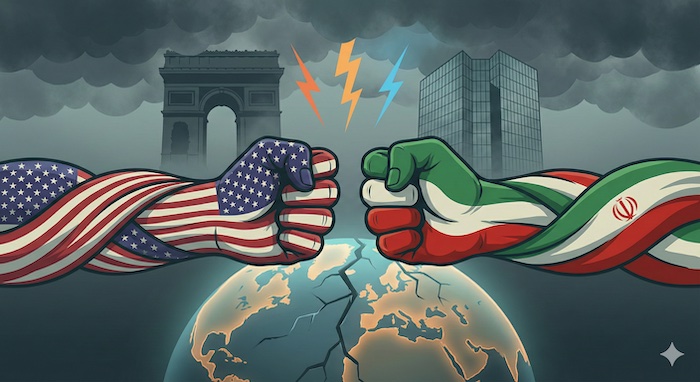

This article is a critical examination of the 2026 US–Iran conflict, its humanitarian toll, and the enduring struggle for self-determination.
The Opening of a New Front
On 28 February 2026, US and Israeli airstrikes hit key Iranian military and political targets. Those strikes killed senior Iranian leaders and triggered an immediate and sustained military response from Tehran.
The conflict, swiftly labelled Operation Epic Fury by US command, did not emerge without warning. Its roots lay in years of escalating tension — sanctions, proxy confrontations, nuclear brinkmanship, and the unresolved legacy of the 2025 Twelve-Day War. Yet its outbreak shocked a global community that had dared to believe diplomacy might yet prevail.
Only days before the first bombs fell, Iranian Foreign Minister Abbas Araghchi declared that a historic agreement to avert conflict was within reach, reaffirming Iran’s opposition to nuclear weapons. Reports subsequently emerged indicating that intense lobbying by Saudi Arabia and Israel had persuaded President Trump to abandon the negotiating table in favour of a military solution.
US officials reportedly proposed that Israel strike first to provide political cover for broader American involvement. What followed was one of the most consequential military escalations in the Middle East since the 2003 invasion of Iraq.
The Human Cost
The human toll of the conflict has been staggering. Within its first six days alone, the war cost an estimated USD 12.7 billion. That figure speaks only to the financial ledger and nothing of the suffering inscribed on the bodies of ordinary Iranians.
By mid-March 2026, conservative estimates placed Iranian military casualties between 3,000 and 4,800 dead, while civilian deaths had exceeded 3,000. A single US-Israeli airstrike near a school in the city of Minab killed 180 people, the overwhelming majority of them children.
More than 6,600 structures including residential buildings, commercial premises, and medical facilities had been destroyed or severely damaged. Internet access was largely severed across Iran, with the government resorting to the distribution of SIM cards primarily for the purposes of state propaganda.
UNESCO issued urgent calls for the protection of Iran’s cultural heritage sites, many of which stood in the path of the advancing bombardment. In Lebanon, parallel Israeli military operations had produced over 1,000 fatalities and displaced more than one million civilians. Iraq, too, bore the consequences of US-Israeli strikes against Iran-backed forces on its soil.
These are not abstractions. They are the texture of a humanitarian catastrophe unfolding in real time. It is uncomfortably comparable to the ongoing destruction in Gaza. Gaza is a parallel drawn explicitly by educators, trade unionists, and civil society organisations in countries including Australia, whose government’s involvement in the conflict has attracted fierce domestic criticism.
Australia’s Complicity
Prime Minister Anthony Albanese and Foreign Minister Penny Wong publicly affirmed Australia’s alignment with US military objectives from the outset of hostilities. Critics, including the Committee for Public Education (CFPE), which convened an emergency meeting to condemn the war, argued that this amounted to an endorsement of an illegal conflict.
The Pine Gap joint intelligence facility in the Northern Territory, long a cornerstone of US surveillance and targeting operations in the region, drew particular scrutiny. Australia’s participation in AUKUS and its commitment to increased defence spending were cited as evidence of a deepening subservience to American imperial strategy.
The parallel with Gaza is not merely rhetorical. In both theatres, US military support has underwritten attacks on schools and hospitals, and in both cases the Australian government has chosen strategic loyalty over humanitarian principle. For many Australians, and particularly for those within migrant and diaspora communities with direct ties to the affected regions, this complicity is not a matter of foreign policy abstraction but one of profound personal and moral consequence.
The Question of Legality
The illegal nature of the joint US, Israeli-led campaign has been apparent from the moment the first strikes were authorised. No US congressional declaration of war was sought or obtained. The War Powers Resolution, invoked by members of Congress seeking to curtail the President’s military authority, failed in the face of Republican opposition.
Legal scholars and international law practitioners questioned the basis for what the US characterised as preventive action. They noted that Iran’s retaliatory strikes — while devastating in their own right, including attacks on US installations across the Persian Gulf and the targeting of US-flagged tankers — could be construed as a legally defensible response to prior aggression.
The United Nations Security Council passed Resolution 2817 on 11 March 2026, demanding that Iran cease its attacks on Gulf shipping lanes. Conspicuously, the resolution made no mention of the US and Israeli strikes that had precipitated those very attacks. The asymmetry was not lost on nations across the Global South. Condemnation of US and Israeli conduct was widespread and, in some cases, accompanied by significant domestic unrest — most notably in Pakistan, where pro-Iranian protests prompted military deployments.
The Geopolitical Landscape
This conflict has redrawn strategic alignments with considerable speed. Analysts suggest that sustained US military engagement in Iran may diminish Chinese influence across the Gulf region, even as it complicates American capacity to maintain pressure on Russia over Ukraine.
The Houthis in Yemen, though exercising military restraint, have expressed firm political solidarity with Tehran and signalled readiness for escalation should circumstances demand it. Global oil prices have surged dramatically, with the Strait of Hormuz largely closed to shipping, raising the spectre of recession-inducing inflation across world economies.
President Trump’s announcement of the assassination of Supreme Leader Ali Khamenei on March 1 marked a further and deeply destabilising escalation. In its aftermath, Iranian military operations intensified, while the Iranian Foreign Ministry itself acknowledged diminished governmental control over parts of the country.
Israel’s subsequent targeted killings of Ali Larijani and several other leaders raised new alarms about the scope and character of the US and Israeli operation. Rather than the swift decapitation followed by democratic transformation promised by some of its architects, this military campaign has produced a fragmented, volatile, and increasingly ungovernable situation on the ground.
Image Source: sikhsiyasatnews.net