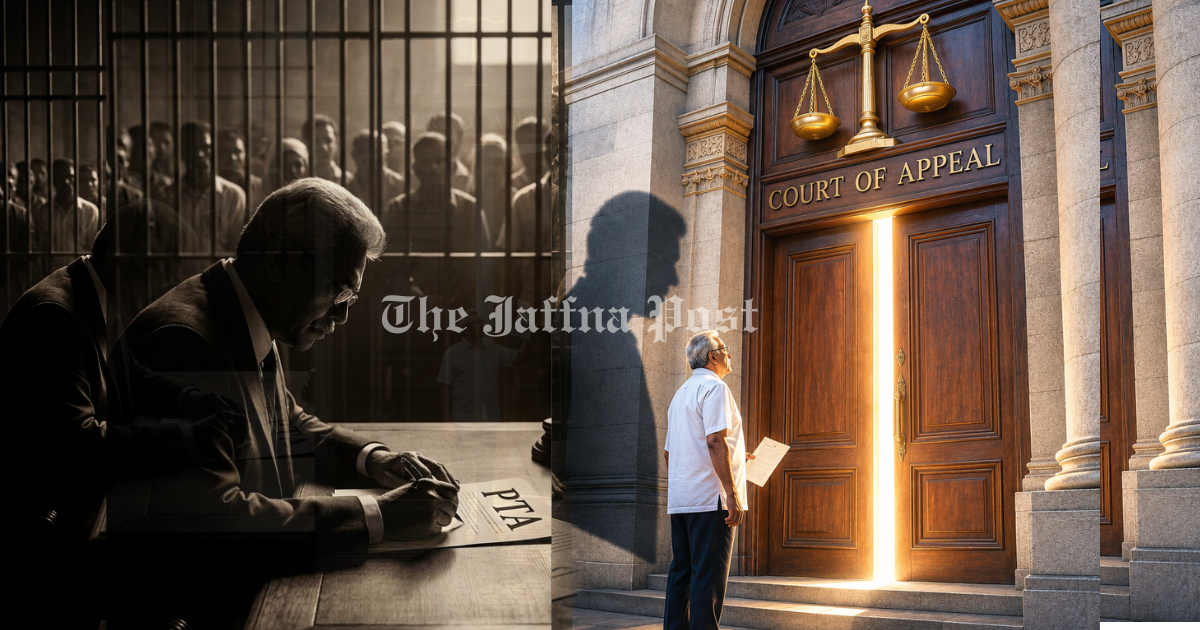

The petition filed in the Court of Appeal by former President Gotabaya Rajapaksa, requesting an order to prevent the police from arresting him under the Prevention of Terrorism Act (PTA), is a significant milestone in Sri Lanka’s legal history. This is because it represents a complete reversal of roles.
During his tenures first as Defense Secretary and later as Executive President, Gotabaya was severely criticized by international human rights organizations for using the PTA to target political opponents, as well as civil society activists voicing support for human and civil rights. Today, we see this same military-political leader seeking the protection of the court to escape from that very same law.
Gotabaya’s petition fundamentally seeks an ‘interim relief’. That is, while the legal arguments regarding the allegations and investigations against him remain pending in court, the petition requests a judicial order preventing the police or the Criminal Investigation Department (CID) from arresting him.
Similar to the arguments put forward by many before Gotabaya, his lawyers may also argue that any move to arrest him under the PTA is politically motivated or lacks a reasonable legal basis.
One of the most draconian provisions of the PTA is that it has a very low threshold for arresting an individual. This law allows for the arrest and detention of a person purely on suspicion, without an arrest warrant.
Sri Lanka has an unfortunate history filled with experiences of many innocent people spending the majority of their lives under the PTA—a law that was initially introduced as a temporary measure but later became permanent and has been in force for 47 years.
The fact that a former president has preemptively approached the court to prevent such an arrest underscores the sweeping scope of power granted to the executive through the PTA.
If the Court of Appeal grants the order as requested in Gotabaya’s petition, it will reveal the extent to which a former president enjoys immunity or protection from counter-terrorism laws. This will establish a new legal precedent. Conversely, if the petition is rejected, it will demonstrate that no one is above the provisions of the PTA.
Relying on the judiciary today to protect himself from the very same PTA he once wielded is viewed as a major irony in the current political landscape.