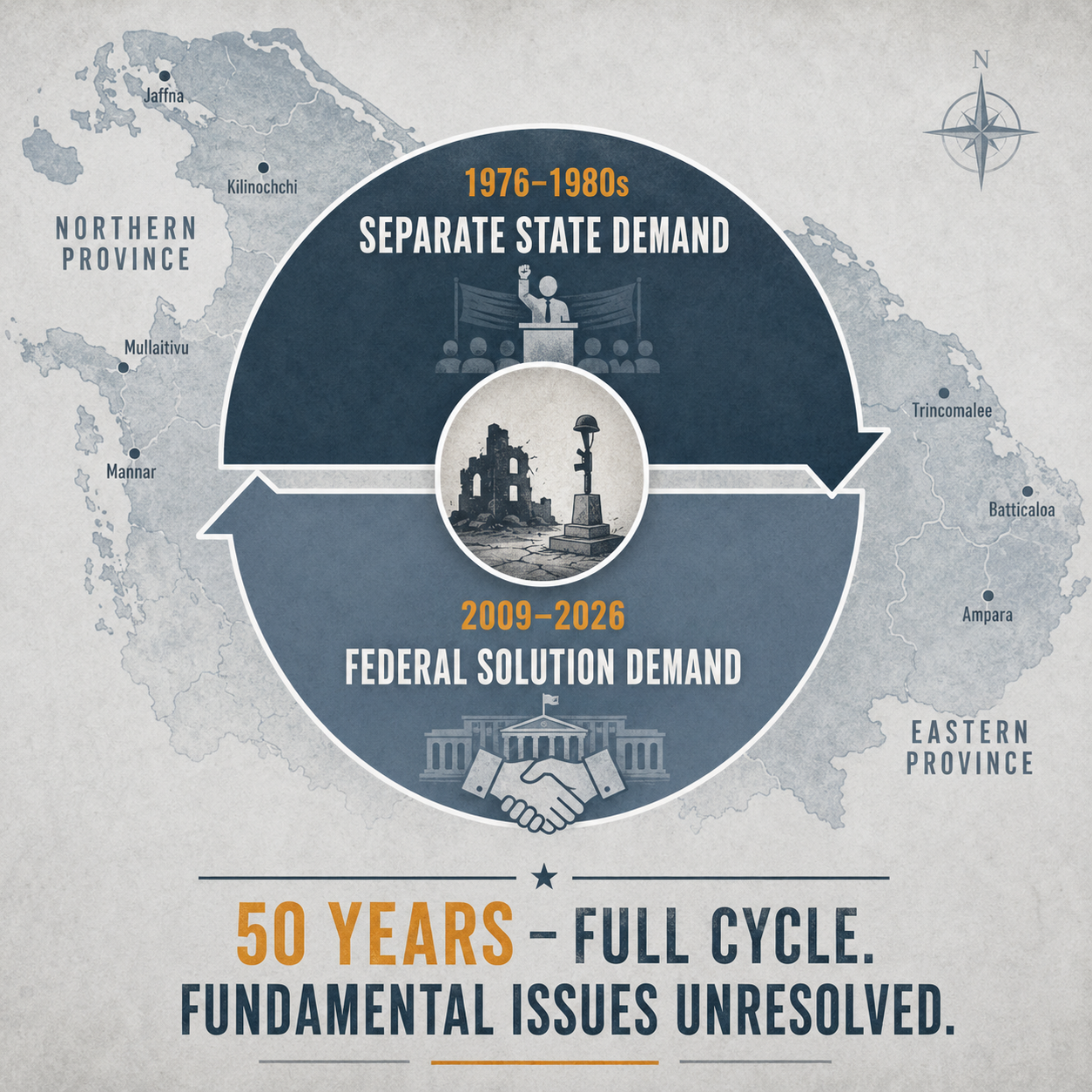

May 14 marked exactly 50 years since the Vaddukkoddai Resolution, a milestone in the political history of Sri Lankan Tamils.
Passed on May 14, 1976, at the convention of the Tamil United Liberation Front (TULF) in Vaddukkoddai, this resolution drew a definitive line in the sand, ensuring that the trajectory of Tamil politics and ethnic relations would never be the same again.
At a time when a negotiated political settlement to the national ethnic issue seemed impossible, the resolution proclaimed that there was no salvation for Tamils other than a separate state.
The TULF used the July 1977 general elections to seek a mandate for this proclamation from the people of the North and East—the traditional homeland of the Tamils.
Despite securing a massive victory in 18 constituencies across both provinces, and claiming that the Tamil people had granted a mandate for a separate state, the TULF lacked a practical road map to implement that mandate.
By 1981, while serving as the main opposition in Parliament, the Front was forced to accept the District Development Councils (DDC) as a temporary solution. As a result, the leadership of the struggle for the Tamil’s political rights, inevitably shifted toward armed militant groups.
Recent history shows how the struggles waged by these groups to achieve ‘Tamil Eelam’, which the TULF leaders could not deliver, eventually escalated into a full-scale war. Ironically, this struggle became an example not of how to achieve a separate state, but of how it remains unattainable.
It is significant to note that the Ilankai Tamil Arasu Kachchi (ITAK), the primary constituent of the TULF, abandoned its quarter-century-long demand for a federal system to embrace the call for a separate state.
Today, 50 years after that policy declaration and 17 years since the end of the civil war, history has come full circle. We now see all Tamil nationalist parties once again advocating for a solution based on a federal system.
Within this period, where the political struggle of the Sri Lankan Tamils has completed a full cycle, the tragedies of war have drastically transformed the political landscape of the North and East. It is against this backdrop that the Vaddukkoaddai Resolution reaches its half-century mark.
Though the political circumstances that prompted the demand for a separate state have changed significantly, the fundamental issues that triggered that demand remain unresolved.
The polity in Southern Sri Lanka largely operates under the impression that a political solution to the ethnic issue is no longer necessary following the end of the war. The Tamil polity currently finds itself unable to launch any powerful political movement capable of exerting pressure on the government.
This is the stark reality half a century later. Today’s Tamil political forces, who view ‘memories’ as their greatest weapon, are commemorating the Vaddukkoaddai Resolution… and that is all.