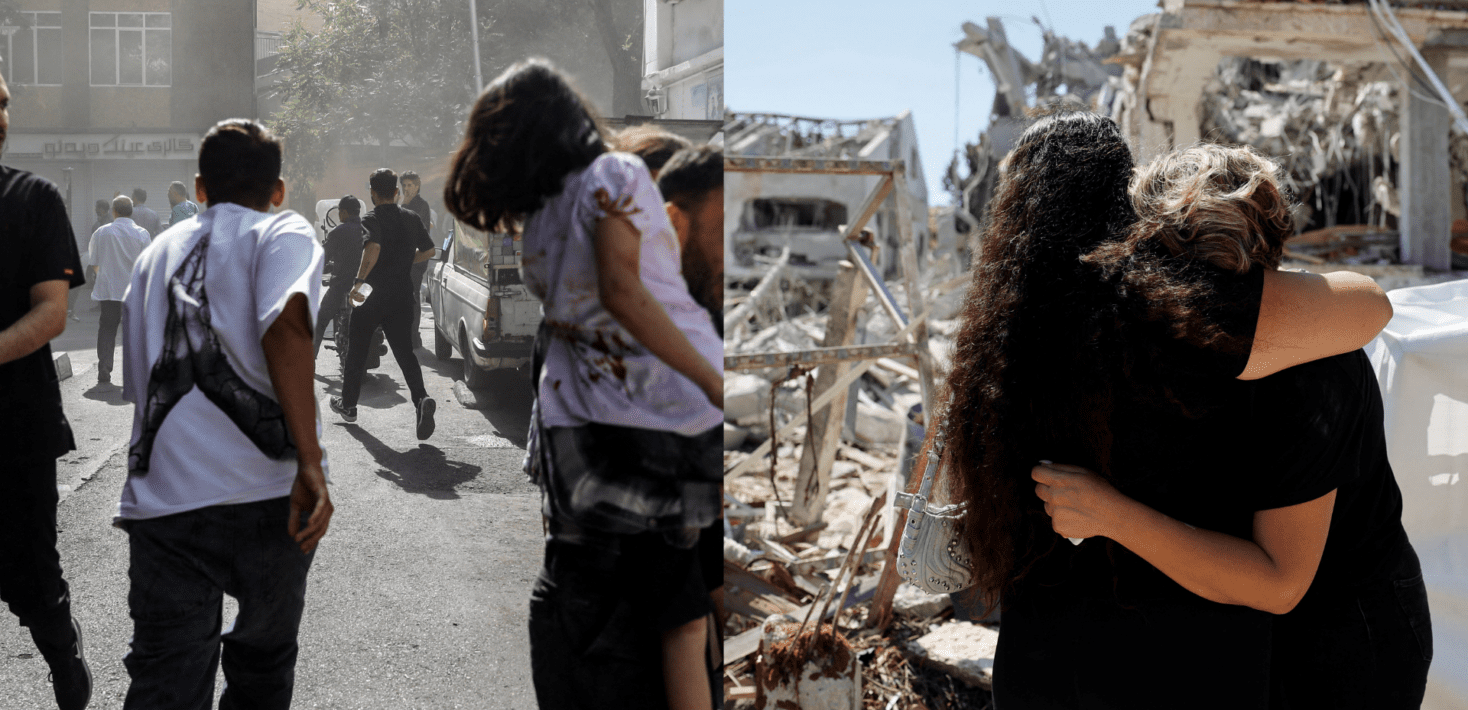

This article is a critical examination of the 2026 US–Iran conflict, its humanitarian toll, and the enduring struggle for self-determination.
The People of Iran
How Iranians themselves have responded to these events is complex. The death of Khamenei prompted celebrations among sections of the diaspora and, reportedly, among some within Iran, where opposition to the Islamic Republic has deep and legitimate roots. Reza Pahlavi, the exiled son of the last Shah, endorsed the US strikes while calling for the protection of civilians. Kurdish Iranian leaders in northern Iraq expressed conditional support for a US ground operation, though they denied any planned military coordination.
Yet alongside these reactions ran a countervailing current: the refusal of many Iranians to welcome foreign bombs as the vehicle of their liberation. The Islamic Republic, for all its authoritarianism, like the banning of independent trade unions, the denial of free elections, the holding of political prisoners, the violent repression of the Woman Life Freedom Woman, Life, Freedom (Jin, Jiyan, Azadî) protest movement and the protests sparked by the death of Mahsa Amini — has not met with widespread revolt.
The history of the 1979 Revolution demonstrated what Iranians could achieve through collective mobilisation. The history of the 1953 CIA-orchestrated coup against Prime Minister Mohammad Mosaddegh demonstrated, with equal clarity, what foreign intervention produces: not democracy, but deeper authoritarianism and durable nationalist grievance.
It would be a grave error to suppose that the removal of the Islamic Republic’s leadership by external military force could serve as a reliable pathway to democratic transition. The institutional infrastructure for such a transition — independent unions, civil society organisations, opposition networks capable of governing — has been systematically dismantled over decades of repression.
In the absence of these structures, the most likely outcomes are either a consolidation of emergency powers under a new strongman, or a prolonged and bloody fragmentation of state authority.
Resistance, Culture, and the Long View
Even in the darkest of circumstances, resistance persists. Iranian filmmaker Jafar Panahi is subject to a two-decade ban on making films. However, he has continued to create. And in doing so, he has embodied the insistence of Iranian civil society on its own survival. Poetry, underground cinema, independent journalism, clandestine labour organising – these are not merely gestures of defiance; they are the architecture of a future Iran that can only be built by Iranians themselves.
The fourteenth-century poet Hafez (Ḥāfeẓ-e Shīrāzī)— beloved across the Persian-speaking world and venerated as a ‘poet’s poet’ and a universal voice of love — knew something about the moral hypocrisies of power, and about the gap between proclaimed righteousness and actual conduct. His verses resonate with renewed urgency in the present moment, when those directing the bombs speak the language of liberation while producing the conditions of catastrophe.
In this sense, the cultural resistance of Iran’s artists and intellectuals is not peripheral to the political struggle. It is central to it, keeping alive the possibility of a society that foreign military planners cannot bomb into existence and do not understand.
Escalation and the Double Standard of Terror
Israeli Defence Minister Israel Katz indicated a significant rise in US and Israeli military operations against Iran, with US Admiral Brad Cooper stating that over 8,000 Iranian military targets had been struck, including 130 vessels.
On 21 March, US strikes were conducted on the Natanz Nuclear Facility using bunker buster bombs. Russia condemned it as a ‘blatant violation of international law,’ calling for restraint from the International Atomic Energy Agency (IAEA).
In retaliation, Iran targeted the Israeli town of Dimona, injuring 78, followed by another strike on Arad, which resulted in over 116 injuries. Reports by CNN and The Wall Street Journal mentioned an unsuccessful Iranian missile attack on the US – UK military base at Diego Garcia, which was intercepted. Iran denied involvement, attributing the incident to an Israeli provocation.
The Houthi movement in Yemen threatened repercussions against any escalation concerning Iran, cautioning Bahrain and the UAE about their involvement in the Strait of Hormuz operations. Trump issued an ultimatum to Iran to open the Strait of Hormuz, threatening retaliatory strikes against Iranian power plants. Iran responded by threatening to close the Strait and attack vital regional infrastructure.
Amid escalating tensions, including claims of shooting down an F-15, Trump postponed military strikes for five days, asserting negotiations with Iran were in progress. Iran rejected and ridiculed this claim, branding it deceitful and suggesting plans against US and Israeli interests were underway.
Trump labels Iran the ‘Number One State Sponsor of Terror’ and threatens to obliterate its power plants if the Strait of Hormuz isn’t opened. Yet by his own logic, one must ask: Does decades-long economic warfare through sanctions against Cuba, Venezuela, and Iran, deliberately designed to cripple civilian populations, not meet the same threshold? If choking a nation’s economy to force political submission is not state-sponsored terror, the definition seems to depend entirely on who holds the megaphone.
The Pentagon is expected to deploy soon a brigade combat team of about 3,000 soldiers from the Army’s elite 82nd Airborne Division, known as the ‘Immediate Response Force’, specialized in parachute assaults, to the Middle East to support operations against Iran, according to reports. While widely reported, the deployment has not been officially confirmed by the Pentagon, which cites operational security.
Water as a Weapon of War
Water has historically been utilised as a tool of control in the Israeli-Palestinian conflict and, as of early 2026, has emerged as a critical ‘weapon of war’ within the escalating US-Israeli confrontation with Iran.
With the Persian Gulf region heavily reliant on desalination for potable water, infrastructure in this area is increasingly targeted, turning essential water resources into strategic targets, according to the latest reports. Oxfam and UN experts have accused Israel of using ‘thirst as a weapon’ by deliberately restricting water access and destroying water and sanitation infrastructure in Gaza.
This has resulted in a 94% reduction in available water. Since October 2023, Israeli military operations have damaged or destroyed 89% of Gaza’s water and sanitation facilities, including wells, desalination units, and pipelines.
During the conflict that began in late February 2026, both sides have targeted critical water infrastructure. Iranian officials claimed the US attacked a desalination plant on Qeshm Island, shutting off water to 30 villages, while Bahrain reported a drone attack on its desalination infrastructure.
The Gulf states (Kuwait, Qatar, UAE, Saudi Arabia, Bahrain, Oman) are heavily reliant on over 400 desalination plants. Qatar and Bahrain obtain over 90% of their drinking water from these systems. Iran has threatened to target desalination plants in the Gulf—specifically in the UAE and Bahrain—if Iranian infrastructure is attacked by the U.S. or Israel. Disabling these plants would cause severe suffering for millions, and experts warn that such attacks constitute a ‘war crime’.
Conclusion: Against the Logic of an Imperial War
The war on Iran was made possible by decades of bipartisan American hawkishness, by Israeli strategic calculation, by the complicity of allied governments including Australia’s, and by the grotesque spectacle of a US president reportedly contemplating the bombardment of Kharg Island — in his own words — ‘just for fun.’ It has produced mass civilian casualties, environmental destruction, economic disruption, and a humanitarian crisis of the first order. It has not produced democracy, and it will not.
Those who advocate for peace — in Iran, in the United States, in Australia, and across the world — are not naive about the character of the Islamic Republic. They understand, and are prepared to say clearly, that the regime is authoritarian, that it represses its people, that it denies them fundamental freedoms. However, they insist, with equal clarity, that Iranians must determine the fate of Iran. Not by cruise missiles. Not by the machinations of foreign powers with strategic interests to protect. Not by the same imperial logic that has left Iraq, Afghanistan, Libya, and Gaza in ruins.
History teaches that lasting democratic change requires the patient, courageous work of people organising within their own societies — in workplaces, communities, and cultural institutions — against the structures that oppress them. The Iranian people have shown, across decades of struggle, that they are more than equal to that task. What they require is not bombs dropped in their name. What they require is solidarity, and the space needed to determine their own future.
Image Source: amnesty.org