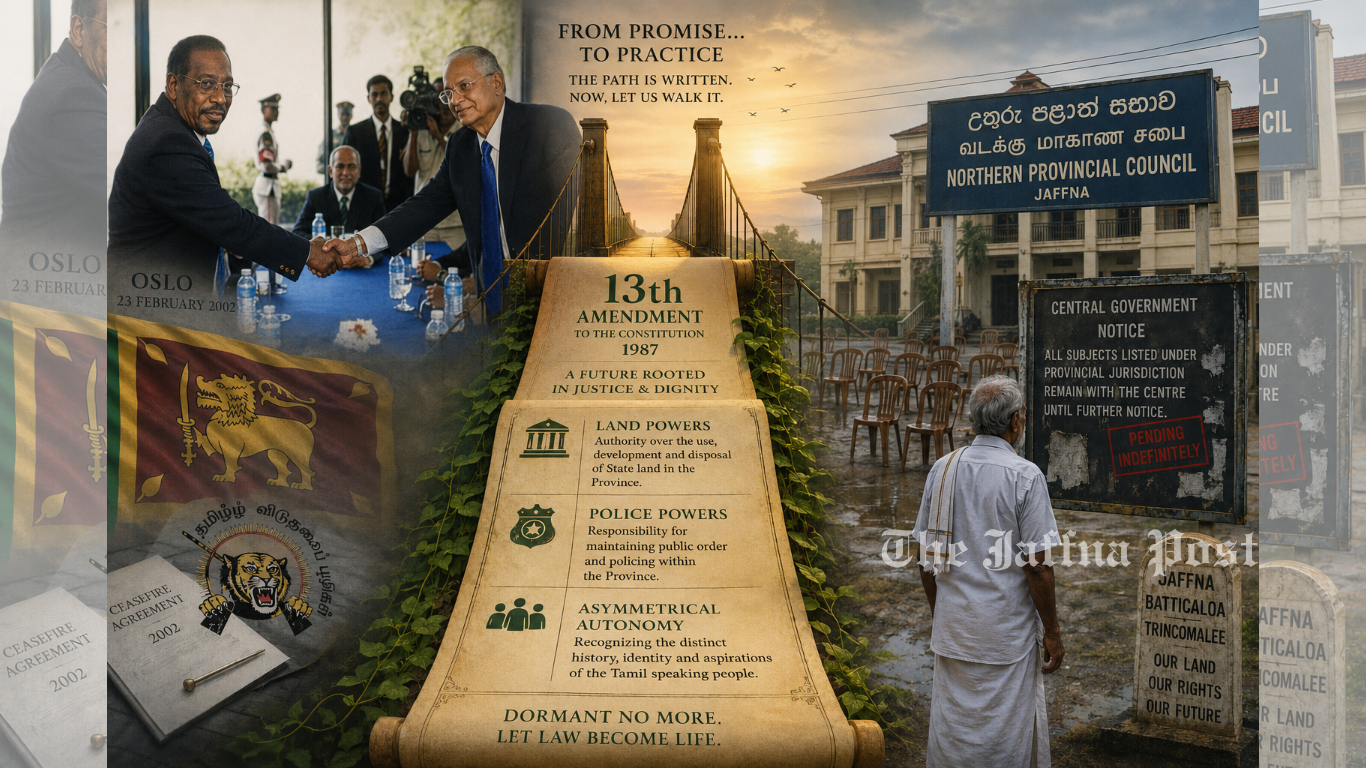

Seventeen years after the end of the Sri Lankan Civil War (1983–2009), Sri Lanka continues to grapple with a fundamental political challenge. That challenge is how to meaningfully accommodate the political aspirations, identity, dignity, security, and self-governance demands of Tamil-speaking people, particularly those in the North and East, within a united Sri Lanka.
In the post-war period, numerous political promises were made. Constitutional reforms were discussed repeatedly. Words such as reconciliation, peace, development, and national unity have dominated political discourse. However, these expressions have largely substituted for genuine structural reform.
As a result, the Tamil national question has not disappeared. It may have been temporarily suppressed, but its underlying legitimacy remains intact. The re-emergence of internal self-determination today is not a radical demand. It is grounded in internationally recognised legal and political principles.
The issue today is not theoretical. It is practical. What form of internal self-determination can realistically be implemented within Sri Lanka’s political and constitutional framework?
The concept of internal self-determination is not new. It was explicitly recognised during the Oslo peace process in December 2002. At that time, both the Government of Sri Lanka and the LTTE agreed to explore a federal solution based on internal self-determination within a united Sri Lanka.
This agreement was historically significant. It acknowledged that the Tamil national question could be addressed through meaningful power-sharing rather than separation. However, the failure to carry forward this process has left a lasting vacuum.
Internal self-determination refers to the right of a people to exercise meaningful control over their political, economic, social, cultural, and administrative affairs within an existing state. It does not imply secession. It does not undermine sovereignty. Rather, it is a mechanism to ensure dignity and equality within a united country.
During the peace process, Tamil political actors clearly stated their willingness to consider a political framework based on meaningful regional autonomy within a united Sri Lanka. Only if such internal arrangements were denied would external self-determination arise as a consequence.
This is not a threat. It is a recognised political reality. When a people are persistently denied rights, the demand for separation becomes a result of that denial, not its starting point.
A major misconception in Sri Lanka is the belief that federalism equals separation. This is incorrect. Federal or quasi-federal systems exist in many countries, including Canada, India, Switzerland, Belgium, and Spain. These systems demonstrate that recognising diversity through power-sharing strengthens national unity. It does not weaken it.
Sri Lanka’s current system of devolution, introduced through the 13th Amendment, has failed to deliver meaningful autonomy. Provincial Councils exist in theory but lack real authority.
Key powers such as land and policing remain centralised. Governors appointed by the President can override elected representatives. Financial dependence further weakens provincial governance. This is not genuine self-rule. It is controlled decentralisation.
The Tamil demand for internal self-determination must also be understood in its historical context. Since independence, successive governments have undermined Tamil political rights.
Agreements such as the Bandaranaike-Chelvanayakam Pact and the Dudley-Chelvanayakam Pact were abandoned. Promises of devolution were not fulfilled. Constitutional reforms remained incomplete. This pattern has created a deep trust deficit.
In this context, portraying internal self-determination as a threat is politically misleading. Such narratives often serve to reassure southern political constituencies rather than address the core issue.
Recent political developments raise further concerns. Discussions about constitutional reform and governance restructuring suggest the possibility of weakening or replacing Provincial Councils with localised administrative systems. Such a shift would be a serious regression.
Local councils cannot replace regional autonomy. They cannot address issues of land, identity, cultural protection, or political representation at a national level. Reducing governance to local administration risks fragmenting Tamil political power.
The critical question is whether internal self-determination leads to separation. The answer is clear: properly implemented internal self-determination prevents separation.
When people feel their identity is recognised, their land protected, their language respected, and their governance rights ensured, they have a strong reason to remain within the state. When these are denied, the risk of alienation increases.
Therefore, separation is not caused by internal self-determination. It is caused by the refusal to grant it. Sri Lanka must adopt a realistic and phased path forward which will include:
– Immediate Provincial Council elections
– Full implementation of the 13th Amendment
– Transfer of land and police powers
– Asymmetrical autonomy for the North and East
– Democratic discussion on the North-East merger
– Strengthening regional economic governance
– Reduction of central interference
These steps do not divide the country. They strengthen unity through fairness. No constitutional framework can succeed without political will. Trust must be rebuilt through action, not words.
Reducing militarisation, respecting land rights, ensuring justice, and promoting inclusive governance are essential. Internal self-determination is not a pathway to division. It is the only realistic alternative to it.
Sri Lanka stands at a critical juncture. It must decide whether to continue with centralised control or move toward meaningful power-sharing.
The Oslo moment demonstrated that a solution is possible. The question is whether Sri Lanka now has the courage to implement it.