Neelan: Unsilenced, a documentary released on July 29th 2025, is an exhaustive and poignant tribute to Dr. Neelan Tiruchelvam, a Tamil constitutional scholar lawyer, academic, human rights activist and politician whose legal acumen and vision for ethnic reconciliation offered Sri Lanka a fleeting chance at peace during its brutal civil war (1983–2009).
Drawing from over two hours of interviews with a myriad of expert speakers, archival footage, and historical analysis, the film by Pitasanna Shanmugathas meticulously chronicles Tiruchelvam’s life, his pivotal role in crafting constitutional reforms, and his tragic assassination by the Liberation Tigers of Tamil Eelam (LTTE) in 1999.
By delving deeply into the legal frameworks he championed – most notably the 1987 Indo-Sri Lanka Peace Accord and the 1995 “Union of Regions” proposals, a significant attempt at constitutional reform aimed at addressing the ethnic conflict, particularly the grievances of the Tamil minority, while maintaining the country’s territorial integrity.
The documentary underscores the power and fragility of constitutional solutions in divided societies. While its scholarly depth illuminates Tiruchelvam’s legacy, the film’s narrative, range of speakers, and emotional resonance are a testament to Tiruchelvam’s legacy, making Pitasanna Shanmugathas’ documentary a compelling call to revive his vision in today’s fractured world.
A Legal Mind Forged in Crisis
The documentary opens with the harrowing 2009 climax of Sri Lanka’s civil war, where government shelling of Tamil civilian areas killed thousands, framing the central question: Could Tiruchelvam’s legal reforms, proposed over a decade earlier, have averted such atrocities?
Born in 1944 in British Ceylon to a politically engaged Tamil family, Tiruchelvam was shaped by his father, Murugeysen Tiruchelvam, a senator and federalist who co-drafted the 1965 Senanayake-Chelvanayakam Pact. This agreement sought to grant Tamils language rights and regional autonomy but faltered due to Sinhalese opposition.
The film vividly recounts how the 1956 Sinhala Only Act, officially known as the Official Language Act No. 33 of 1956, marginalized Tamils by making Sinhala the official language, fueled grievances over access to education, employment, and political power.
Interviews with family members, reveal Neelan’s early exposure to these struggles, including his mother’s Red Cross work during the 1958 anti-Tamil riots and his father’s six-month imprisonment for satyagraha protests against the Act in 1961. These formative experiences drove Tiruchelvam to study law at the University of Ceylon and Harvard, emerging as a global advocate for human rights and pluralism.
The documentary’s strength lies in its detailed exploration of Tiruchelvam’s legal contributions, which aimed to dismantle Sri Lanka’s centralised, unitary state structure – a legacy of the 1972 Constitution that one speaker describes as a “direct slap in the face” to Tamil federalists.
This constitution, enacted under Sirimavo Bandaranaike’s United Front government, entrenched Sinhalese dominance by codifying Sri Lanka as a unitary state, rejecting the federalist platform of the Tamil Federal Party led by S. J. V. Chelvanayakam.
Tiruchelvam, mentored by his father’s defense of Tamil leaders in the 1976 Vaddukoddai Resolution trial (which called for a separate Tamil state), saw constitutional reform as the antidote to ethnic marginalisation. His legal philosophy, as articulated by a Harvard colleague, emphasised “respect for difference” and the linkage between group and individual rights, a principle that guided his work both locally and globally.
Crafting Constitutional Solutions
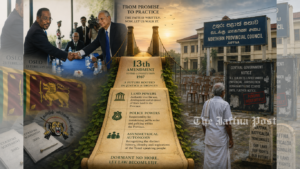
The film’s legal centrepiece is Tiruchelvam’s role in two landmark efforts: the 1987 Indo-Lanka Accord and the 1995 constitutional reform proposals under President Chandrika Kumaratunga. The Accord, negotiated between President J. R. Jayewardene and Indian Prime Minister Rajiv Gandhi, introduced the 13th Amendment, a response to dual insurrections in Sri Lanka’s North (Tamil militants) and South (JVP rebels).
The amendment established provincial councils to devolve power, recognising Sri Lanka as a multi-ethnic state and granting Tamil official language status. However, as one interviewee explains, it was a compromise born of necessity – Jayewardene needed Indian military support (the IPKF) to quell insurrections, but the amendment lacked Sinhalese support.
Tiruchelvam, while supportive of its intent, criticised its flaws: three lists (national, provincial, and concurrent) gave the impression of devolution but allowed the centre to retain sweeping powers. Another notes that “national policy on all subjects, including those devolved to provinces,” remained under central control, rendering regional autonomy illusory. The concurrent list, in particular, enabled the central government to override provincial decisions on land and police, fueling Tamil distrust.
Building on this critique, Tiruchelvam played a leading role in Kumaratunga’s 1995 “Union of Regions” proposals, introduced after her 1994 electoral victory on a pro-peace platform. These reforms, detailed in the film, were unprecedented in scope, proposing to redraw Sri Lanka into eight regions, merge the Tamil-majority North and East, and grant elected councils extensive powers over land, police, and education.
Crucially, the proposals removed the “unitary state” clause, replacing it with an “indissoluble union of regions” to address secession fears while advancing devolution. Tiruchelvam advocated for a Senate to ensure regional representation and judicial review to protect constitutional supremacy – mechanisms absent in Sri Lanka, where, as one expert noted, laws passed by Parliament cannot be challenged for unconstitutionality. This absence, he argued, undermined effective devolution, as the centre could encroach on regional powers unchecked.
The documentary enriches these discussions with Tiruchelvam’s global legal work, which informed his approach. In Kazakhstan, he consulted on the 1995 Constitution, advocating decentralised governance without formal federalism to prevent ethnic enclaves, a compromise driven by concerns over the country’s diverse population (40% Kazakh, 40% Russian, 20% others).
Shanmugathas praises Tiruchelvam’s focus on minority protections and local decision-making, which strengthened individual rights and decentralisation clauses. Similarly, his observation of Chile’s 1988 plebiscite, reinforced his belief in linking human rights with democratic processes. These experiences shaped his insistence on a holistic approach to Sri Lanka’s reforms, integrating Muslim minority concerns and envisioning a multi-ethnic framework that avoided replicating discrimination.
The Collapse of Legal Dialogue
Neelan: Unsilenced unflinchingly chronicles the unraveling of these legal efforts. The LTTE’s April 1995 ceasefire violation, justified by leader Velupillai Prabhakaran as a response to unfulfilled pledges (e.g., lifting economic embargoes and fishing bans), derailed peace talks.
One such interviewee quotes Prabhakaran’s claim that the government conflated Tamil grievances with LTTE demands, viewing them as security threats. Government officials, counter that over 40 letters proposed substantive talks, met with LTTE evasiveness.
The documentary suggests a mutual failure: the LTTE’s refusal to negotiate earnestly and the government’s inability to implement pledges. By 1997 and 2000, the 1995 proposals were diluted under pressure from Sinhalese nationalists and the UNP, who prioritized abolishing the executive presidency.
The documentary notes that securing a two-thirds parliamentary majority required these compromises, but another expert reveals Tiruchelvam’s anguish, quoting him shouting at Kumaratunga, “Is it for this that Neelan gave his life?” The 2000 draft, stripped of key devolution mechanisms and dispute-resolution bodies, was rejected by the TULF, reflecting Tamil disillusionment.
The film’s most devastating moment is Tiruchelvam’s assassination on July 29, 1999, by an LTTE suicide bomber, framed as punishment for his government collaboration. Labeled a “traitor” by Tamil media and diaspora, he was vilified for advocating a democratic solution over separatism.
Interviewees call this a “political act,” noting the LTTE’s censorship of moderate voices, decrying the “social cancer” of eliminating dissenters, exemplified by a Tamil suicide bomber killing a Tamil scholar.
The documentary entwines this tragedy with the broader collapse of legal dialogue, suggesting that the LTTE’s intransigence and the government’s concessions to nationalists doomed Tiruchelvam’s vision. Others recount a chilling LTTE justification: Tiruchelvam was a “tool” whose proposals “never could satisfy Tamil aspirations.” Yet, the film argues that his path — constitutional realignment over armed struggle — remains the only viable solution, especially after the LTTE’s defeat in 2009 left Tamils with “so much loss and destruction.”
Visually, the reliance on talking-head interviews and archival footage cements this documentary as a historical chronology of Neelan’s life; scenes of Jaffna’s war-torn landscapes or cultural elements like Tamil music could have deepened the emotional stakes. The sound design is functional but uninspired, missing opportunities to evoke the conflict’s human toll, such as the 1995 Jaffna school bombing that killed 25 children, mentioned briefly without exploration. A more balanced critique of the government’s role – beyond its failure to implement reforms – would have strengthened the narrative, as would addressing the LTTE’s internal suppression of Tamil dissent more thoroughly.
A Legal Legacy for Today
Neelan: Unsilenced is a vital chronicle of a legal mind who dared to reimagine Sri Lanka as a pluralistic, decentralised state. As Sri Lanka faces economic crises and renewed calls for the 13th Amendment’s full implementation, Tiruchelvam’s advocacy for devolution, judicial review, and minority protections remains a beacon.
His global work – from Kazakhstan’s multi-ethnic constitution to Chile’s democratic transition – underscores the universality of his principles. The documentary urges leaders to revive his vision, ensuring constitutional frameworks foster unity over division. It stands as a powerful call to action in a world grappling with ethnic strife.
Neelan: Unsilenced, the voice reminds us that peace demands not just courage but the legal ingenuity to build bridges where bullets have failed.