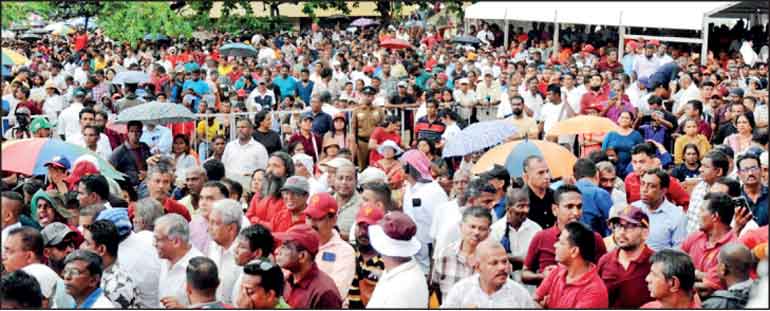

The recent Nugegoda rally has re-energised debate about Sri Lanka’s political direction, the strength of the opposition, and the vulnerabilities of the National People’s Power (NPP) government.
Although the protest drew a noticeable crowd and generated significant media attention, its overall political impact remains mixed. It has exposed both strategic weaknesses and emerging opportunities for different political actors, particularly Namal Rajapaksa, who is positioning himself as a future presidential candidate.
A Divided Opposition and Namal Rajapaksa’s Dilemma
While the rally projected an image of public discontent, it failed to demonstrate a unified opposition. Major parties such as the Samagi Jana Balawegaya (SJB) did not attend, signalling a lack of cohesion among anti-government forces.
Namal Rajapaksa, who dominated the platform, used the moment to promote his national profile and challenge the government’s performance. His speech focused on the grievances of public servants, high taxes and overall dissatisfaction among the middle class.
However, a deeper political risk remains. Without broad-based opposition unity, the protest becomes more of a branding exercise than a consolidated movement.
Namal’s presence gives him visibility but also increases scrutiny. If he cannot translate this momentum into sustained political gains, the event could weaken rather than strengthen his aspirations for higher office.
Implications for the NPP and the Path to Recovery
President Anura Kumara Dissanayake responded by stating that the capitalist forces entrenched over the past 75 years cannot be dismantled within a single year. His comment reflects the reality that reform takes time, but it also highlights the gap between public expectations and government delivery.
The NPP is now confronted with growing public frustration that needs immediate attention. To recover lost ground, the NPP must prioritise visible results, particularly in areas affecting daily life such as taxes, job creation and public services.
Stronger engagement with minority communities in the North and East is essential, as trust in government promises remains fragile. Clear and consistent communication is crucial, especially when delays occur due to structural or bureaucratic challenges. Strengthening relationships with public servants and reducing administrative resistance will also help stabilise the reform program.
Political recovery requires the NPP to reinforce its reform narrative and demonstrate that change is both possible and underway. Visible community-level successes, transparent decision-making and consistent messaging can help rebuild credibility.
If the NPP can convert its moral mandate into tangible improvements, it can regain the public confidence that has begun to waver.