
Travel is often about discovery — of places, cultures, and moments that stay with us long after the journey ends. In Sri Lanka, travel is also about witnessing resilience. In November 2025, Cyclone Ditwah swept across parts of the island, bringing with it heavy rains, flooding, and disruption, particularly to communities in the North Central and Central Provinces.
The cyclone tested the country in profound ways, yet it also revealed something deeply familiar: the unshakeable spirit of its people. The impact of Cyclone Ditwah was felt most acutely in rural heartlands. Prolonged rainfall caused rivers to overflow, reservoirs to breach capacity, and low-lying villages to flood.
In the North Central Province, farming communities faced the loss of crops, livestock, and homes. In the Central Province, landslides and damaged roads isolated entire villages, cutting off access to schools, markets, and healthcare. For many families, the cyclone was not just a weather event — it was a disruption of daily life, livelihoods, and a sense of security.
Images of submerged homes, damaged bridges, and evacuated villages dominated the news in the days that followed. Yet alongside these images were others just as powerful: neighbours carrying children through floodwaters, temples and schools opening their doors as temporary shelters, and volunteers arriving with cooked meals, dry rations, and clothing. In moments of crisis, Sri Lanka’s strongest force has always been its people.
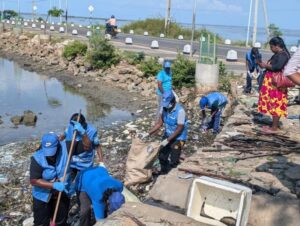
The national response to Cyclone Ditwah was swift and coordinated. The Sri Lanka Army, Navy, Air Force, Police, and disaster response units worked around the clock to evacuate families from high-risk areas. Temporary shelters were set up, medical teams deployed, and essential supplies distributed. Roads blocked by fallen trees, mudslides, and flood debris were cleared with urgency, reconnecting isolated regions within days. Engineers and workers laboured tirelessly to restore damaged bridges and infrastructure, ensuring that transport routes — lifelines for both locals and visitors — were reopened safely.
Equally remarkable was the speed at which daily life began to find its rhythm again. Markets reopened, schools resumed classes, and public transport returned to service. Heritage and cultural sites, including those that had temporarily closed as a precaution, were assessed, cleaned, and reopened. Iconic landmarks such as Sigiriya Rock Fortress, Dambulla Cave Temple, Mihintale, and other historically significant sites welcomed visitors once more, standing as symbols not only of ancient resilience but of modern recovery as well.
For travellers considering Sri Lanka in the wake of Cyclone Ditwah, it is important to understand that recovery here is not about erasing what happened — it is about rebuilding with care, strength, and community. Tourism plays a meaningful role in this process. When travellers return, they support local guides, drivers, hotel staff, artisans, farmers, and small business owners who depend on tourism for their livelihoods. Every visit contributes to healing, not just economically, but emotionally, by reaffirming connection and confidence.
What remains unchanged, even after storms and setbacks, is the essence of Sri Lanka. The warmth of its people is not something that can be washed away. Visitors still encounter smiles offered freely, cups of tea shared with strangers, and conversations that feel less like transactions and more like genuine exchanges. Hospitality here is not a service — it is a way of life.
The landscapes, too, retain their quiet magic. Lush greenery seems to emerge even stronger after the rains. Paddy fields shimmer under returning sunlight, mist curls around hilltops in the Central Highlands, and ancient ruins stand steady, reminding us that this island has weathered centuries of change. The coastline, wildlife reserves, tea plantations, and sacred cities continue to offer experiences that are both grounding and inspiring.
Travelling to Sri Lanka post-Cyclone Ditwah is not about ignoring what the country has endured; it is about acknowledging it, respecting it, and being part of the journey forward. It is about seeing resilience not as a headline, but as something lived daily — in rebuilt homes, repaired roads, reopened temples, and communities that chose compassion over despair.
Sri Lanka’s story has always been one of endurance. From ancient civilizations to modern challenges, the island has adapted, rebuilt, and moved forward — together. Today, as the country stands steady once more, it welcomes travellers not with promises of perfection, but with authenticity, warmth, and hope.
To travel here now is to witness a country that bends, but does not break. It is to experience beauty shaped by resilience and kindness that remains constant, no matter the storm.