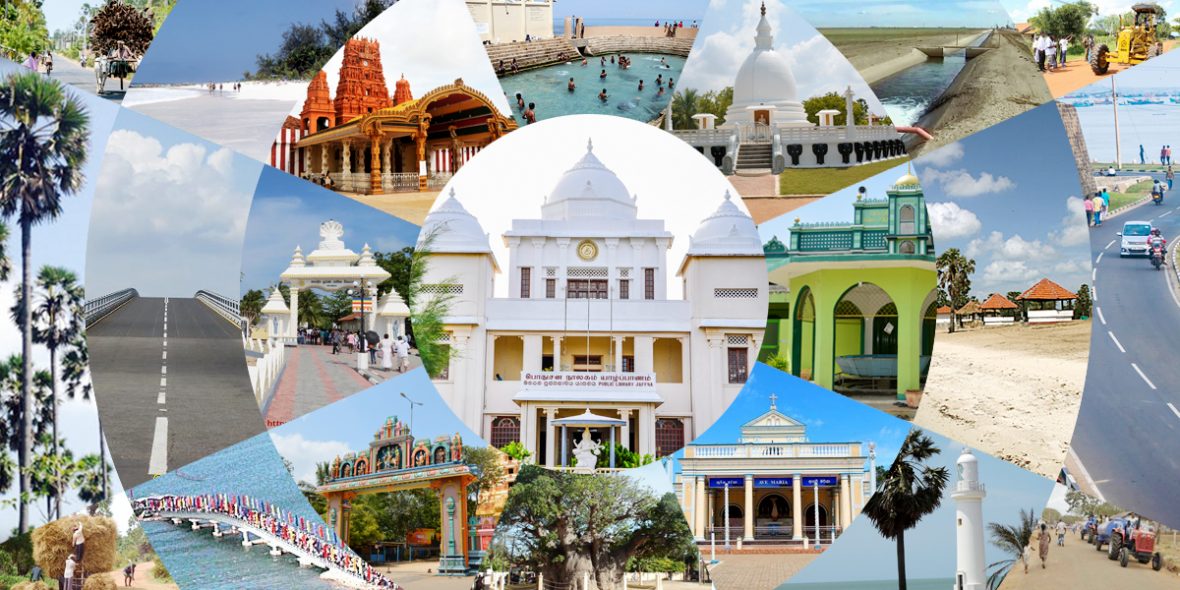

A recent media report spoke of development issues being discussed between the President and ITAK. This article imagines a future north, drawing from a few select ideas developed previously.
Concept of development bonds and pension fund in the province
Approval in principle is required from the President as Minister of Finance to formulate a detailed proposal for approval of development bonds and a pension fund for the province.
As the former Governor, I proposed to raise future funds for development and create a shareholder community of citizens who would prevent any reason to relapse into conflict in the future. This would also ensure equitable share of distribution of surplus wealth generated by the resources of the province, and for wealth creation across all strata of society in the province and to shield the economy from ups and downs.
Objectives include raising private finances for investments, returns and development; Attracting local and foreign investor funds, be it big or small; Generating revenue through investments for development in the province and investments in financial instruments in select global markets; Creating a wealth owning community of citizens from the province, attracting surplus wealth of Sri Lankans overseas; Ensuring profits from revenue from development in the province is earmarked in part to long-stay citizens in the province as a pension fund contributing to a scheme through licensed banks in Sri Lanka; an emphasis on save and grow through part counterpart voluntary contributions of ultimate beneficiaries as a long-term savings plan so that both current and future generations get to benefit.
I envisaged a bonds and pension scheme deposited through CBSL with the Treasury administered by the Governor, Central Bank Governor, Secretary/ Treasury and pro Bono ex office advice for startup phase from Tamaseak Fund Singapore (if they consent) or an entity of equal global eminence or from persons of eminence from India, Vietnam, Singapore possessing required competence.
Development of islands off Jaffna
The natural islands to the West of the Peninsula are a mini-Singapore. They have potential for high end tourism, marinas, building of boats and yachts, docking of yachts, re-creation of heritage towns such as Kayts, landing bays for sea planes to name a few. The potential is similar to what Singapore has achieved with lesser assets.
The air route to Jaffna from Chennai is now operational. Other destinations in India will likely develop. Ferries from the South of India have become a reality. Given these developments, it makes sense to create a mini-Singapore as a leisure destination from Jaffna down to Mannar and towards Trincomalee from the eastern side.
Tourism with the Indian market should be a priority. These include catering to bike clubs, religious tourism, high end niche tourism, tourists seeking house boats and duty-free shopping. Since tourism is a priority nationally, it follows that it should spill over to the province with a gigantic market across the waters.
The fruits of development must also propel improvements in infrastruture and quality of life of islanders which are currently in an extremely poor state.
An India conclave
India has produced over 100 unicorns. India now boasts of giving birth to 1 out of every 10 unicorns globally today. The term ‘unicorn’ refers to the rarest of the rare start-ups who attain a valuation of more than $1 billion. The India government launched the Skill India initiative in 2015 to train over 40 crore Indians in different industry-related jobs.
The vision has created an empowered workforce with the help of various schemes and training courses. This combined effort has propelled India to become a super power in research, technology, innovation, and manufacturing supported by a skilled, efficient workforce.
An Extended Common Market with states of India encapsulating benefits to the whole of the island is possible. An India-Sri Lanka conclave involving the top leadership drawing from government and commerce should be considered.
The Indian High Commission had laid the ground work with several high-profile consultations already in Colombo. Some areas of focus include tourism, healthcare and diagnostics, education and training including teachers and nurses, seeds and agriculture, renewable energy, electronic servicing and digitization, wind turbine manufacturing
Special purpose compacts with cities around the world
Special Purpose compacts with cities in the UK, Norway, Switzerland, EU, USA, Canada, ASEAN, Australia, New Zealand, Gulf States and some African States are possible with specific economic drivers as a focus.
Schools as learning hubs
Schools are some of the most underutilized assets. Many are used sparingly outside of school hours. Building connections using a learning hub in a technology-rich learning environment with both physical and virtual components can provide formal and informal opportunities for learners to come together with peers, teachers, and other experts in their field.
A learning hub is a flexible learning environment that is supplied with all required components to teach, engage, and entertain students. Learning hubs can host formal or informal education processes, and they encourage the collaboration of students and teachers and the community.
Integrating support services to drive educational outcomes in the Northern Province
The main objective is to provide access to education and skills with the IT information highway in the Northern Province.
Sub objectives are: Providing basic ICT, English and distance learning through school-based labs; Provide comprehensive training in all aspects of ICT training; Training for computer-based learning in the classroom; IT hubs for higher education; IT labs for PPP ventures.
Service providers and stakeholders include the Governor’s Secretariat Northern Province, Ministry of Education, University of Moratuwa, Mahapola Fund, the Ministry or new agency spearheading IT, and higher education content and certification providers from Tamil Nadu.
Courses would be conducted during regular school hours, after school classes for post O/L and A/L students, adult education post school hours, weekend classes for teachers with long distance learning courses.
The plan is to provide basic ICT, English and distance learning training to teachers through schools-based labs. The requirements include: Form a project coordination and management team; Stock-take IT skills of teachers and students with aptitude to teach; Link with content providers. e.g. UoM , TN Ministry for IT ; Test and upgrade hardware; Identify students .i.e. school going and adults including NP cadre; Define usage and hours of usage; Cost; Provide comprehensive training in all aspects of ICT training; Planning meetings with local and foreign experts; Harness open source material; Invite call for interest from other specialized recognized content providers; Training for computer based learning in the classroom; Plan delivery schedule and deliver; IT hubs for higher education; Call for interest from service providers and arrive at MoU’s; Initiate programmes, IT labs for PPP ventures and cost recovery and revenue generation through PPP for training and BPO’s.
Image Source: Northern Provincial Council Tourism Bureau
https://np.gov.lk/northern-provincial-road-passenger-transport-authority-copy/