
Agriculture or the production of food has framed the history of social development through millenia. Honed over centuries of tending to a land and its soils, a traditional understanding of a crop and its needs is what the phenomenon of agriculture produced.
Sri Lanka provides a good example. Here, irrigated rice production demonstrates a sophisticated system of water collection and control. The rice farming landscape maintained a high biodiversity component, that had co-evolved with the management cycles of the land. The grain itself was not only a source of carbohydrate, but also a source of selected minerals and nutritional compounds, as seen in the variety and composition of the grain.
At the last reckoning (1950), there were 500 named varieties each with different, color, shape and texture complexes, that were recorded. This diversity was the first victim to the industrialization of agriculture.
Today it is difficult to find more than 20 that remain within the farming communities. In traditional farming systems, farming demanded a knowledge of the environment. A farmer, to be successful required an intimate knowledge of the land and the changes that seasonality brought to it. There was always the drive to produce more but productivity of the traditional system was limited to the optimal biological energy. In terms of energy, it was always internal – the soil, farm livestock and the farmers’ energy to produce food.
In rice production, this system was recorded to have a yield of about 2000 kg per hectare around 1960. With the onset of agricultural development focused on productivity, this level of yield was seen to be insufficient and an agricultural development program that focused on crop intensification began.
The changes began with the introduction of hybrids and artificial fertilizer. Under this approach, crop plants were bred to have smaller leaf and root biomass and the production was concentrated in harvestable biomass.
One problem with this approach, is that while it takes a smaller root mass to absorb the fertilizer efficiently, there are no other roots extending outwards, providing root exudates into the soil microbial community to keep the soil alive.
The fossil-based fertilizer are salts that are taken by the plant to create rapid growth. But such growth is at the expense of its natural defenses, bringing about attacks by pests which then have to be controlled using pesticides. It is a downward spiral.
The gain in crop yield using the industrial approach is impressive; by 2025 it was at 4700 kg. But there was a significant cost to attain this level of productivity.
In terms of energy, roughly 6.4 MJ of energy is required to produce 1.0 kg of rice, all of this energy is fossil based. This change, from traditional agriculture to industrial agriculture meant moving from having no need of fossil energy to provide 1MJ of food, to needing over 6.4 MJ of fossil energy to do the same with industrial agriculture.
Further, the toxic nature of many of these inputs have been clearly demonstrated by the decline of the health and well-being of our farming population. Thus, if agricultural productivity keeps on depending on fossil inputs, the decline of public health will become a fact.
But, the international agro-industrial complex defends their market by promoting the ‘safety’ of these toxins. Public statements questioning banning of proven toxic compounds claiming them to be ‘benign pesticides like glyphosate’, suggesting, that ‘they do not cause kidney disease and cancer.’
Having been a personal participant in the battle to protect the health of our people by maintaining the ban on Glyphosate, I have witnessed the hypocrisy around the use and safety of such toxins in our agricultural environment. Biologists claiming conservation goals, suddenly become cheerleaders for Glyphosate.
The insensitivity and cruelty of such people becomes clear, when they state that they would see our farmers suffer and die with poisoning today, because of a hypothetical possibility of a famine tomorrow.
As a defender of such poison stated publicly, “If the hybrids and their chemicals disappear tomorrow, many more people would die of starvation than the number who die of poisoning now. Reality is a hard thing.” What a bitter, tragic, statement.
In a more sensitive world, we should strive towards addressing the current tragedy and reducing the number of people dying today from agricultural toxins, while looking for alternatives that can help us maintain productivity without toxins into the future.
Then there is the reality of climate change. It was in 2015 at the Paris COP on biodiversity that the Sri Lankan position paper was presented stating that: “We are aware that the optimum operating temperature of chlorophyll is at 37 degrees C. In a warming world where temperatures will soar well above that, food production will be severely impacted. We would request the IPCC to address responses to this phenomenon.”
Up till today, the agricultural establishment has carefully ignored this reality. We needed a strong program of adaptation where crop seeds would be bred for heat resistance.
Why is a heat wave so dangerous? Apart from the heat stress in human and animals, it could exceed the threshold for enzymatic activity. All of agriculture depends on the good growth of plants, all plants rely on their chlorophyll to grow and produce.
Chlorophyll is a molecule that functions to an optimum at about 37 degrees; above that their performance falls. In heat waves exceeding 39 degrees, plant productivity will be impacted and yields drop. A brutal spring heat wave in Australia, reduced farmers’ yields and demonstrated the oncoming danger. This reality is now with us and we still do not have heat resistance bred into the seeds.
To compound the ambient heat problem, landscape considerations in the current trend is to simplify the cropping area so that machines can work more efficiently. But this style of management just compounds the problem.
In an industrial monoculture, all trees and shrubs in a cropping land are removed for efficiency of operation. To change the landscape in this manner is to remove all the cooling elements on it. A large tree, for instance produces the cooling equivalent of 9 room size air conditioners working non-stop, all day. A group of trees around a farm could make a difference to its level of productivity.
It has become obvious that the current approach to agriculture with its total dependency on fossil energy to provide food, places us in a path of dangerous dependency. It is also evident that our traditional methods of production too have a limit in productivity. So how do we proceed? One way might be to adopt the approach of a successful neighbor. Earlier this year the President of Vietnam addressed the Sri Lankan parliament where he stated the way that Vietnam approached the challenges
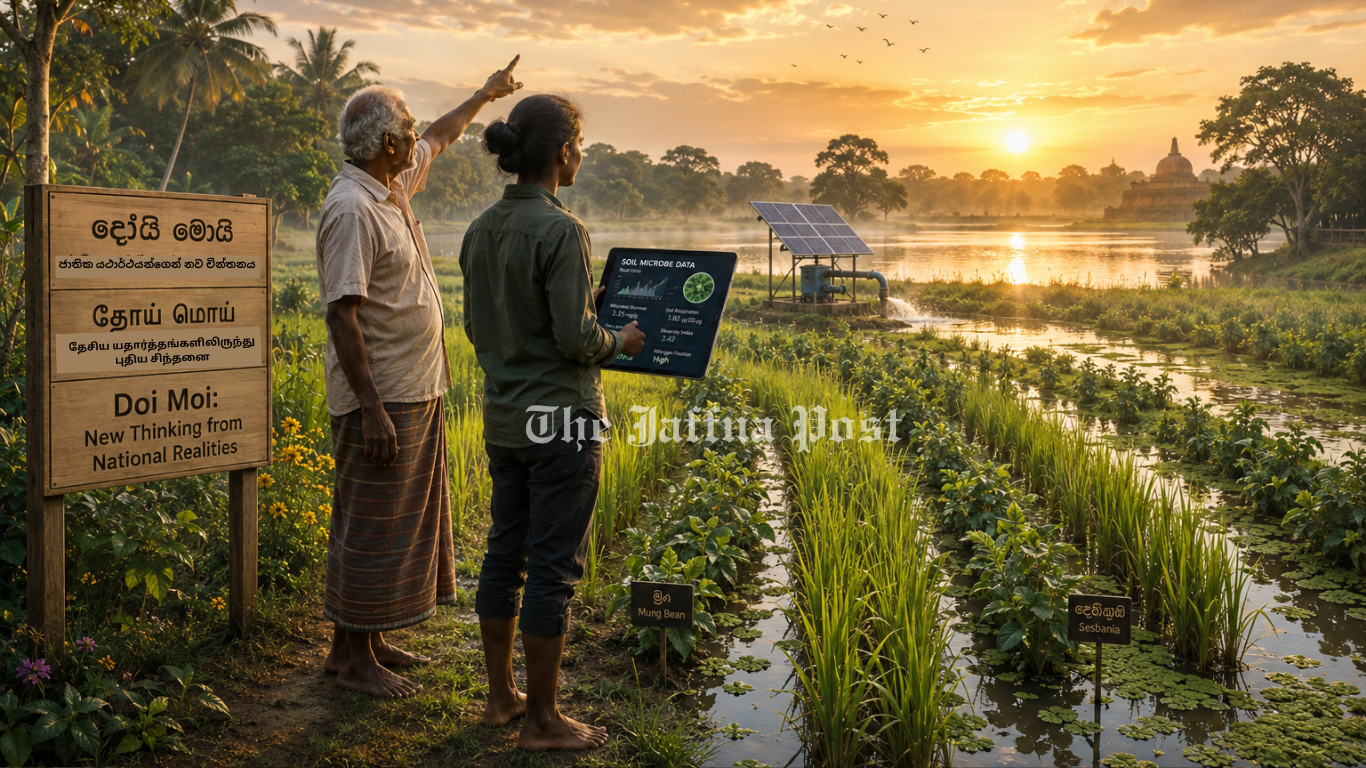
They faced their development challenges with a philosophy of ‘Doi Moi’. Doi Moi means a new way of thinking and that the direction of growth ‘must stem from national realities.
Can we build a modern, scientific, agricultural system which is rooted in the reality of our traditions? Can we wean our agricultural system away from fossil dependency? Can we adapt our agriculture to be resilient to the changing climate? Can we build modern farmers who can interact with the environment in a dynamic and productive manner and not be just agricultural contractors totally dependent external input?