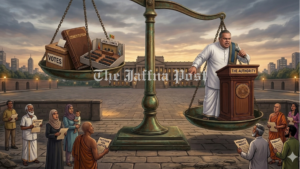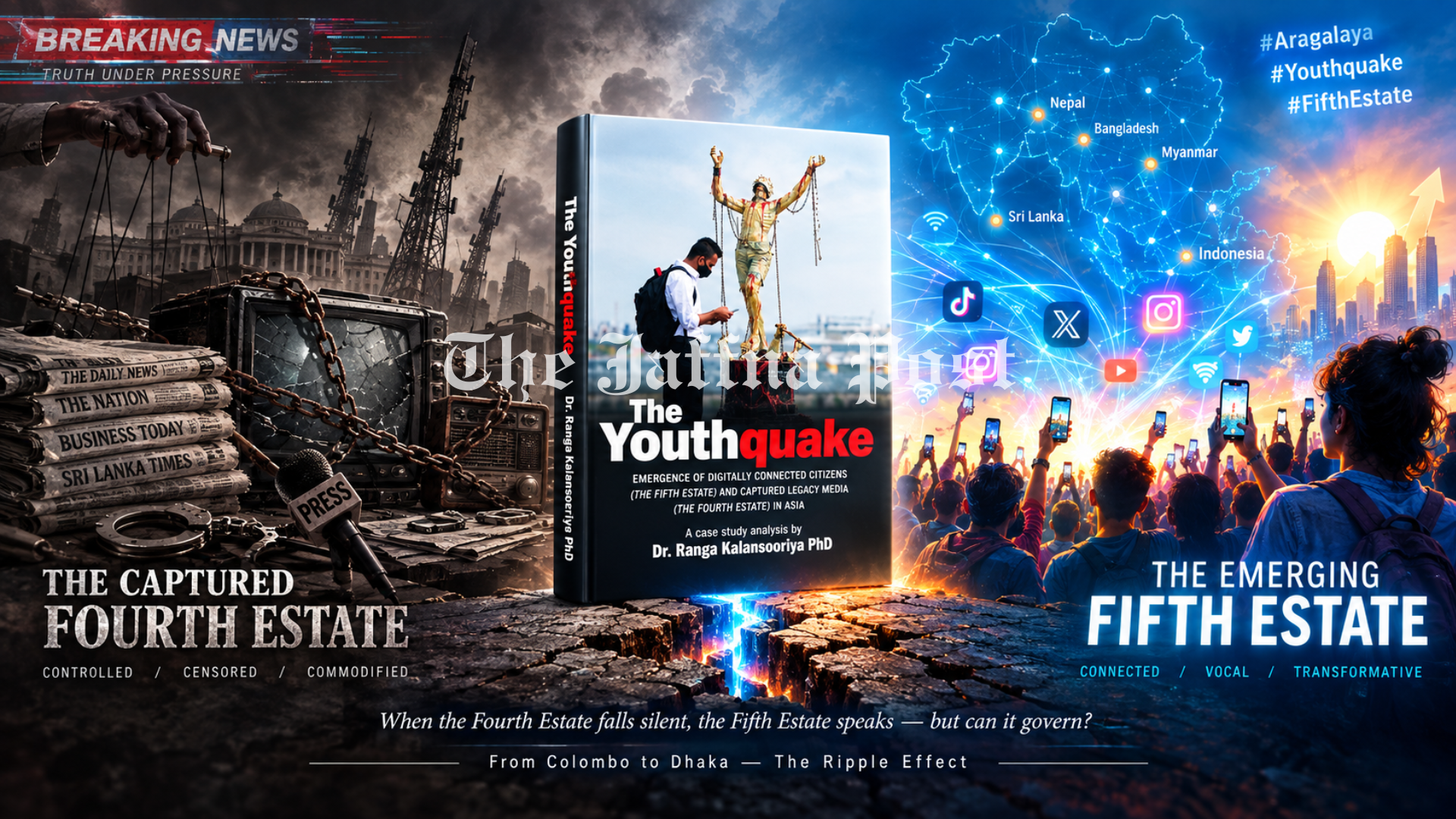

Recently launched at a high-profile gathering of local and international scholars at the BMICH in Colombo, Dr. Ranga Kalansooriya’s The Youthquake”: Emergence of the Fifth Estate vs The Captured Fourth in Asia arrives at a pivotal moment in Asian political history.
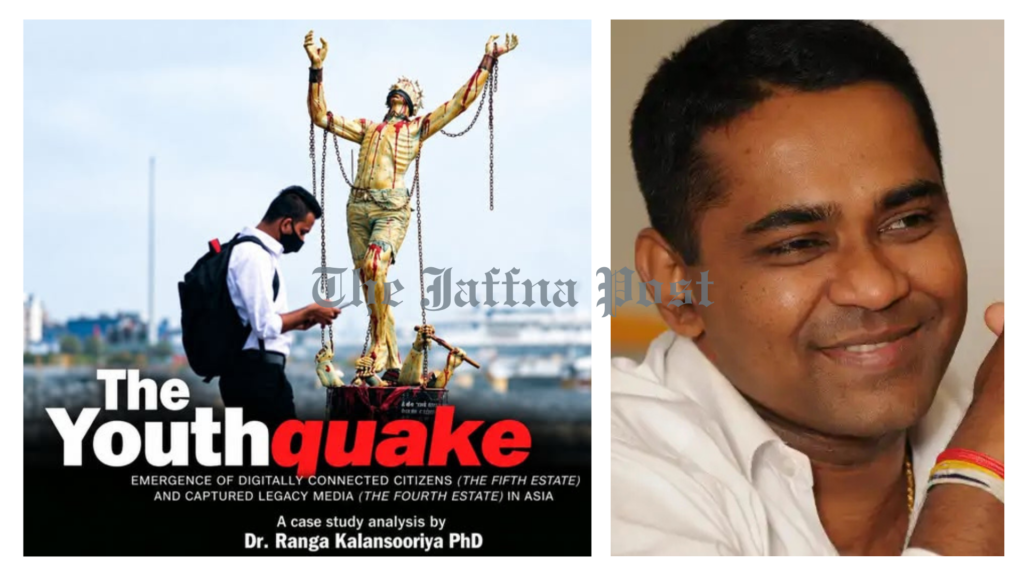
Dr. Kalansooriya is a veteran in international media development, Regional Advisor for International Media Support (IMS), former Director General of Government Information, and Sri Lanka’s first PhD holder in Journalism. He brings over three decades of media expertise to this rigorous, field-tested analysis of how digital networks are fundamentally rewriting the rules of democracy in Asia.
The Collapse of the Fourth Estate and the Rise of the Fifth
The foundational premise of the book explores a critical democratic failure: the ‘Captured Fourth Estate’. Across the Asian region, mainstream media and professional journalism have increasingly fallen victim to ‘media capture’, compromised by heavy-handed political agendas and commercial interests. This has led to a catastrophic collapse of public trust in traditional media.
Into this vacuum steps the ‘Fifth Estate’, a concept originally coined by Oxford Internet Institute’s Prof. William Dutton, which Kalansooriya masterfully adapts to the Asian context. Armed with smartphones and social media, a hyper-connected Gen Z has bypassed traditional gatekeepers to shape their own narratives, mobilise public opinion, and directly challenge entrenched political power.
From Colombo to Dhaka: The Ripple Effect
The book draws its empirical strength from extensive studies across Sri Lanka, Bangladesh, Nepal, Myanmar, and Indonesia. Kalansooriya meticulously connects the dots between regional uprisings, noting that while the immediate triggers may differ, the underlying fuels are identical: systemic corruption, rampant nepotism, lack of transparency, and severe economic mismanagement.
The text draws powerful parallels between Sri Lanka’s 2022 Aragalaya (the citizens’ struggle) that ousted the ruling regime, and the 2024 student-led protests that resulted in the dramatic fall of Sheikh Hasina’s government in Bangladesh.
In both instances, the unparalleled organisational power of the digital Fifth Estate proved capable of achieving what traditional political opposition could not.
The ‘Unresolved Limits’ of Digital Revolutions
However, the Youthquake is far from a romanticised celebration of hashtag activism. Its most crucial contribution is its sobering examination of the ‘unresolved limits’ of youth digital power.
Kalansooriya explicitly warns of an institutional crisis that follows digital uprisings. A smartphone-wielding youth movement can successfully dismantle corrupt regimes and shatter the status quo overnight, but it cannot draft policy, manage state institutions, or establish a stable democratic framework.
Furthermore, the digital space is fraught with its own existential threats: coordinated disinformation, hate speech, and the polarising effects of social media algorithms.
The Verdict
Ultimately, The Youthquake argues that while the rise of the Fifth Estate is a necessary and welcome disruption, it cannot function in a vacuum. A stable, healthy democracy still desperately requires a rehabilitated, independent, and ethical ‘Fourth Estate’.
Professional, investigative journalism remains indispensable for grounding public debate and holding power accountable in the aftermath of a revolution.
Dr. Kalansooriya’s work is a vital, scholarly, yet highly accessible contribution to political science and media studies. It offers a grounded reality check on the triumphs and tribulations of the digital citizen, making it essential reading for anyone trying to understand the delicate balance between media, state governance, and citizen power in the modern age.