Douglas Devananda is the man with nine lives—or, in his case, more than a dozen. He’s outwitted death time and again, surviving challenges that would have brought down others. But now, it seems his long and storied parliamentary career has finally come to an end.
Will he rise again, like the Phoenix?
By Ananth Palakidnar
After earning a reputation as a prominent Jaffna parliamentarian who served continuously for three decades, former Minister and Eelam People’s Democratic Party (EPDP) leader Douglas Devananda met his political “Waterloo” in the parliamentary elections held on November 14 of this year.
Devananda, who began his career as a militant fighting for an independent Tamil state, later shifted toward a more moderate political stance, aligning himself with the government. Throughout his political journey, he faced numerous life-threatening challenges, particularly after founding the EPDP, a party symbolized by the Dravidian musical instrument, the “Veenai” (a type of veena).
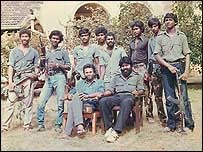
He received his early education at Jaffna Central College and later joined the Eelam People’s Revolutionary Liberation Front (EPRLF), led by K. Pathmanabha. During the early days of Tamil militancy, Devananda, along with Pathmanabha and other
cadres, trained in guerrilla warfare alongside Palestinian rebels in Lebanon.
Political observers often compared him to Charles de Gaulle, the late French leader who survived multiple assassination attempts. Like de Gaulle, Devananda experienced numerous close calls with death. One of his first narrow escapes occurred in the early 1980s when a boat carrying him and a group of EPRLF cadres capsized in the Palk Straits.
In 1983, Devananda was imprisoned at Welikada under the Prevention of Terrorism Act (PTA) when a violent riot broke out, resulting in the gruesome deaths of several Tamil prisoners at the hands of Sinhalese prisoners. Devananda narrowly escaped death after the prison guard on duty refused to hand over the keys to the rioting attackers. Following this incident, Tamil prisoners were relocated to Batticaloa for their safety. It was from there that Devananda and several others escaped in a jailbreak and fled to India by boat, where they continued their militant activities.
However, after the assassination of his leader K. Pathmanabha by the LTTE, and the growing threat of the LTTE annihilating rival Tamil militant groups, Devananda shifted his allegiances. He chose to support the Sri Lankan armed forces both militarily and politically, founding the EPDP as a political party that sought to counter the LTTE. His party not only participated in humanitarian efforts in the Jaffna Islets but also worked closely with the armed forces to curb LTTE activities in the North, East, and even Colombo.
Under the guidance of then-Defense Minister Ranjan Wijeratne, Devananda’s EPDP closely aligned with the government of late

President Ranasinghe Premadasa. However, Devananda’s political career was far from easy. He navigated a dangerous landscape, surviving multiple threats to his life while establishing himself as a prominent figure in Sri Lankan politics.
Devananda entered Parliament in the mid-1980s and went on to represent the Jaffna constituency for three decades. He also held several ministerial portfolios, including Minister of Fisheries. During this time, he worked tirelessly to address the grievances of the people in Jaffna, particularly those who had endured immense hardship during the decades of civil conflict.
In the mid-1980s, upon returning to Colombo from India, Devananda set up his office on Chithra Lane in Narahenpitiya and later at Park Road in Bambalapitiya. After the defeat of the LTTE in 2009, he established his office at the now-defunct Srithar Cinema in Jaffna, which had been built in the early 1980s with state-of-the-art facilities. The cinema hall became the headquarters of the EPDP and its auxiliary armed wing.
As a minister in various governments, including those of former President Chandrika Bandaranaike and other subsequent leaders, Devananda worked to alleviate the suffering of Jaffna’s people, many of whom had faced devastating losses during the civil war.
After three decades of service, Devananda’s political career came to an end with his defeat in the November 14 parliamentary election. While he was expected to retain his seat in Jaffna, the rise of the National People’s Power (NPP) party made a significant impact in the region, allowing the NPP to secure three seats in Jaffna and oust Devananda.
Devananda’s defeat marked the end of an era at his political headquarters, Srithar Cinema. Despite this, his legacy as one of the longest-serving Tamil parliamentarians, and a politician who risked his life more than any other to serve the people of the war-torn North and East, will remain firmly etched in Sri Lanka’s political history.