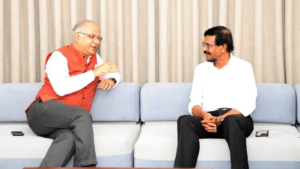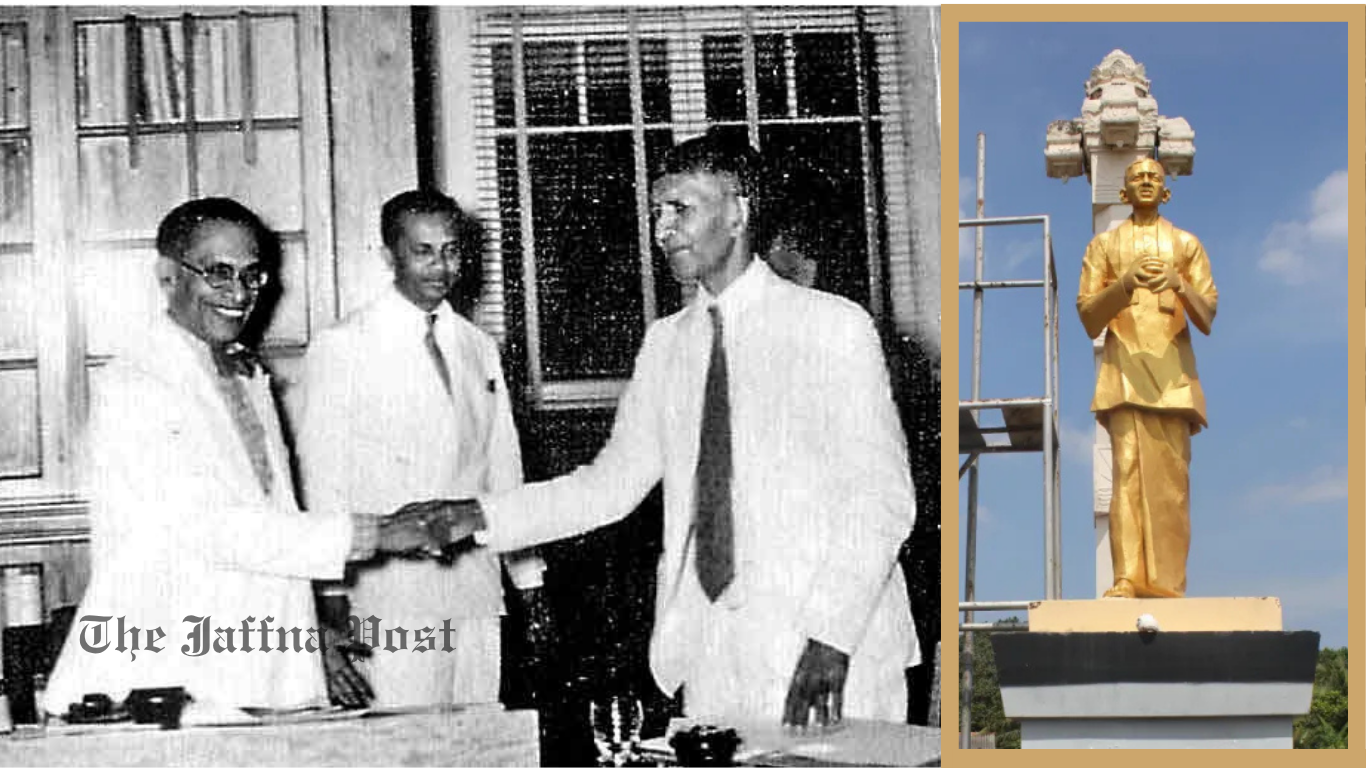

To mark the 49th remembrance anniversary of the veteran Tamil political leader S. J. V. Chelvanayakam (affectionately known as Thanthai Chelva), ITAK and the Thanthai Chelva Memorial Trust jointly organized a memorial lecture last week at the Thanthai Chelva Auditorium in Jaffna.
Professor G.L. Peiris, who has held key portfolios such as Minister of Constitutional Affairs and Minister of Foreign Affairs in various governments over the last three decades, delivered the memorial lecture titled ‘Federalism and the Paths to Constitutional Reform’.
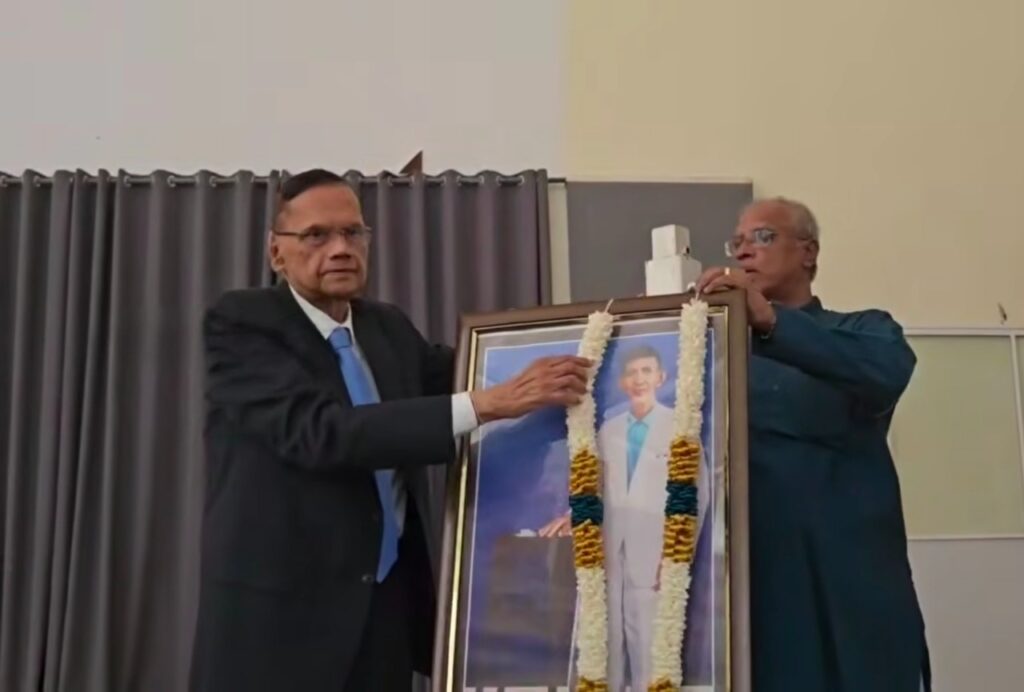
The decision to invite the Professor drew various criticisms from certain circles among Tamils, particularly across social media. However, delivering the welcome address, ITAK spokesperson and former Member of Parliament M. A. Sumanthiran noted that at a time when all Tamil political parties hold a unanimous stance, that a political solution to the national ethnic issue must be found based on federalism and the right to internal self-determination, inviting him to deliver this lecture was a significant moment.
Sumanthiran stated that it was Thanthai Chelva who first sowed the ideology among the Sri Lankan Tamil people that, as a distinct nation, they are entitled to autonomy based on the right to self-determination. To justify why there could be no better person than Professor Peiris to deliver this lecture, Sumanthiran highlighted two of his major contributions.
During the constitutional reform efforts under President Chandrika Bandaranaike Kumaratunga, Professor Peiris, along with constitutional expert and former TULF MP Dr. Neelan Thiruchelvam, drafted a landmark document that largely incorporated federal features.
Following a series of negotiations between the Sri Lankan government delegation (led by the Professor) and the LTTE in the early 2000s, both parties agreed in Oslo, Norway, to explore a political solution based on a federal structure within a united Sri Lanka, rooted in the principle of internal self-determination.
There is no doubt that among all the constitutional reform efforts undertaken during the civil war to reach a political settlement, the document prepared by Professor Peiris and Neelan Thiruchelvam was comparatively the best.
Had there been an opportunity to properly communicate those proposals to the Tamil people at that time, they would have certainly gained widespread support.
The fact that the LTTE chose to assassinate a person like Neelan Thiruchelvam by a suicide bombing, suggests they understood how significantly that document could impact their own political agenda.
Ultimately, the Chandrika government’s document fell victim to the traditional political culture of the South, where the opposition opposes any political solution brought by the government, and governments lack the political courage to stand their ground.
In his speech, Professor Peiris briefly explained both that document and the Oslo Declaration.
As it is essential for today’s younger generation to be aware of these historical milestones, of which the relevant portions are being reproduced here;
Historical Milestones
“Federalism, as a concept, represents a spectrum rather than a split. This is brought out clearly in three sets of constitutional proposals by the Chandrika Kumaratunga administration during the period 1995 to 1997.
They oscillated from one end of the spectrum to the other in establishing the line of demarcation between the functions of the central government and the periphery, in a coherent constitutional scheme.
“I would like, at this point, to pay tribute to the legacy of a valued friend and colleague, Dr. Neelan Thiruchelvam, who co-authored with me, as Minister for Constitutional Affairs, Ethnic Affairs, and National Integration, with the support of many others, including Dr. Jayampathy Wickramaratna, the proposals of 1995, 1996, and 1997.
Neelan, who had been a fellow undergraduate in the University of Sri Lanka, had proceeded to Harvard University, while I was the recipient of a Rhodes Scholarship at Oxford.
“A further coincidence was the entry of both of us together into the Parliament of Sri Lanka in August 1994. He was brutally assassinated because he stood in the way of the LTTE’s claim to exclusivity of representation of the interests and aspirations of the Tamil people. The future might well have been different, had he lived.
“The Constitution Proposals of 1995 embodied strong features of federalism, and indeed went well beyond. Regional Councils, forming the gist of the proposals, were vested with executive, legislative and judicial competence in the subjects assigned to them.
In all key areas, these powers were to be protected against encroachment by the centre. With regard to finance, Regional Councils were to have powers of taxation, including international borrowings and the power to promote foreign investment, international grants and development assistance.
“In the crucial area of law and order and policing, provision was to be made for a regional police service headed by a regional police commissioner appointed by the Chief Minister.
Land was clearly identified as a devolved subject, and state land within a region was to be vested in the Regional Council, with limited reservations in respect of requirements by the central government.
This document represents the strongest movement towards a federal structure in the entire evolutionary process in Sri Lanka.
“The Proposals of 1995 were modified by a more detailed draft in 1996, which represented a regressive development. The basic weakness consisted of conferment of awesome powers on the Presidency, fundamentally altering the balance of power between the Centre and the regions, and making the latter vulnerable to capricious exercise of discretion which could strike at the very root of the regions’ authority.
The mere ipse dixit of the President was to prevail in a situation where the entire sweep of the regions’ powers, entrenched by constitutional provisions, was sought to be negated by executive action at the Centre, no recourse being available to the region for access to the courts. This was hardly likely to inspire confidence.
“A corrective trend then set in, resulting in a further set of Proposals published in 1997. The solution chosen this time was conferment on the regions of a power, to veto proposed constitutional amendments to the content of the chapter on devolution of power to the regions and the two schedules to the draft constitution which dealt with the scope of the regions’ powers and the division of powers between the centre and the regions.
A drastic curtailment of Parliament’s powers, this was movement from one extreme to the other. Invitation to arbitrary action was shifted from centre to periphery. It is scarcely surprising that these Proposals were seen to contain within them the seeds of their own destruction.
“The most elaborate and thorough response to the widely acknowledged imperative of constitutional reform was contained in the Constitution Bill which, as Minister for Constitutional Affairs, I presented on behalf of President Kumaratunga on 3 August 2000.
While the nomenclature of federalism was not specifically invoked, its essence was captured in the provision that the Republic of Sri Lanka shall consist of “the institutions of the centre and the regions”.
The legislative power of the people was to be exercised “by Parliament and by Regional Councils”, while the executive power of the people was to be exercised not only by the President, but also by “the Governors acting on the advice of the respective Chief Ministers and Regional Boards of Ministers”.
Governors of regions were to be appointed by the President “in consultation with the Prime Minister and with the concurrence of the Chief Minister of the region.”
“Exclusivity of legislative power in respect of devolved subjects was explicitly conferred on the regions. No element of equivocation characterised treatment of the controversial subjects of land and police powers.
With regard to the former, the applicable provision was that “Every region shall succeed to all state land within the region and be at the disposal of the regional administration of that region for the purposes set out in the regional list.”
“As for the latter, there was to be “a regional police service for each region, headed by a regional police commissioner who shall be appointed by the regional police commission with the concurrence of the Board of Ministers of the region.” Equally striking on the subject of finance was the amplitude of authority conferred through the Consolidated Fund of the region.
“Robust hostility of the LTTE to implementation of these proposals as the core of a constitutional settlement had its gruesome manifestation in the brutal killing of Dr. Neelan Tiruchelvam. The chilling effect on the major Tamil formation in Parliament, the Tamil National Alliance, of which Dr. Tiruchelvam had been an active member, was overbearing.
“Compounding the problems was the attitude of the main opposition party, the United National Party, which was disinclined to cooperate after their narrow defeat in the presidential election of December 1999. It was the nation’s misfortune that the culture of adversarial politics trumped a national initiative, compelling the government to withdraw the Bill during the debate in Parliament.”
Oslo Declaration
“The theory that the LTTE, at a decisive phase of the peace negotiations, deliberately jettisoned the option of external self-determination, is total delusion. This was a myth around what came to be known as the “Oslo Declaration” during the third session of talks in the Norwegian capital.
At the end of this session, the official communique by the facilitators declared: “The parties agreed to explore a solution founded on the principles of internal self-determination in areas of historical habitation of the Tamil speaking peoples, based on a federal structure within a united Sri Lanka.
The LTTE’s understanding of “internal self-determination”, however, was set out with clarity in the following statement: “We are prepared to consider favourably a political framework that offers substantial regional autonomy and self-government in our homeland on the basis of our right to internal self-determination”.
But the sword of Damocles was ever present. The caveat was added, with unrelenting emphasis, that “If this internal element of self-determination is blocked and denied, and the demand for regional self-rule is rejected, we have no alternative other than to secede and form an independent state.” The LTTE, then, left wide open the option of external self-determination.
“They purported to derive authority for their position from the United Nations Declaration in 1970 on Principles of International Law concerning Friendly Relations and Cooperation among States and from the judgment of the Supreme Court of Canada in 1998 in the Quebec Secession case.
The LTTE’s rigid stance was expressed with precision in their proposal for the establishment of an Interim Self-Governing Authority and the conferment of all-encompassing jurisdiction upon it: “The ISGA shall have plenary power for the governance of the North-East, including powers in relation to resettlement, rehabilitation, reconstruction and development, including improvement and upgrading of existing services and facilities, raising revenue, including imposition of taxes, revenue, levies and duties, law and order, and over land.”
It was added for good measure that, “These powers shall include all powers and functions in relation to regional administration exercised by the government of Sri Lanka in and for the North-East.”
“This was, in all but name, the blueprint of a separate state.This went well beyond the solution which Mr. Chelvanayakam, in his mature judgment, deemed feasible in the political and economic context of our country.”
Not a Single Word About Provincial Councils
In his speech, Professor Peiris listed a chronological sequence of all past efforts; the 1931 Donoughmore Constitution, the 1948 Soulbury Constitution, the 1957 Banda-Chelva Pact, the 1965 Dudley-Chelva Pact, the 1972 First Republican Constitution, the 1976 Vaddukoddai Resolution, the 1981 District Development Councils Act, the 1983 Black July, the 1991 Mangala Moonesinghe Select Committee, the Norway-mediated peace efforts (2002–2006), and the 2004 Tsunami Relief Structure (P-TOMS).
However, he notably omitted any mention of the 1987 Indo-Lanka Accord, the 13th Amendment to the Constitution, or Provincial Councils.
When all internal attempts to resolve the ethnic conflict failed, it was the Provincial Council system, brought about by India’s direct intervention, that became the reality.
Despite elections not being held for the past decade, this system has been in place for 38 years, and the 13th Amendment remains a part of the Constitution.
Professor Peiris has been vocal in Southern Sri Lanka, alongside opposition parties, demanding that Provincial Council elections be held without further delay. Therefore, his silence on the matter while in Jaffna raises suspicion that it was a deliberate act.
On the day before the memorial lecture, during discussions held at M.A. Sumanthiran’s residence in Jaffna with representatives of the ITAK and the Democratic Tamil National Alliance, Peiris had indeed discussed Provincial Council elections.
Furthermore, it is reliably understood that during that meeting, the Professor emphasized the need to launch a protest movement to pressure the government, joining forces with Karu Jayasuriya, the former Speaker and leader of the National Movement for Social Justice, who has been tirelessly calling for the immediate conduct of these elections.
It appears he intentionally avoided these topics because he did not wish to align himself with the demand of most Tamil parties for the full implementation of the 13th Amendment.
When opposition parties in the South call for Provincial Council elections, it is driven by the expectation that the National People’s Power (NPP) will face a worse electoral decline than they did in the 2025 local government elections, rather than out of a democratic concern for returning provincial administration to elected representatives.
In his welcome address, Sumanthiran remarked that the Memorial Lecture delivered by the Professor would resonate long after, both inside and outside the hall.
Whether Peiris’ speech resonates outside or not, his silence regarding the Provincial Councils is heard loud and clear.