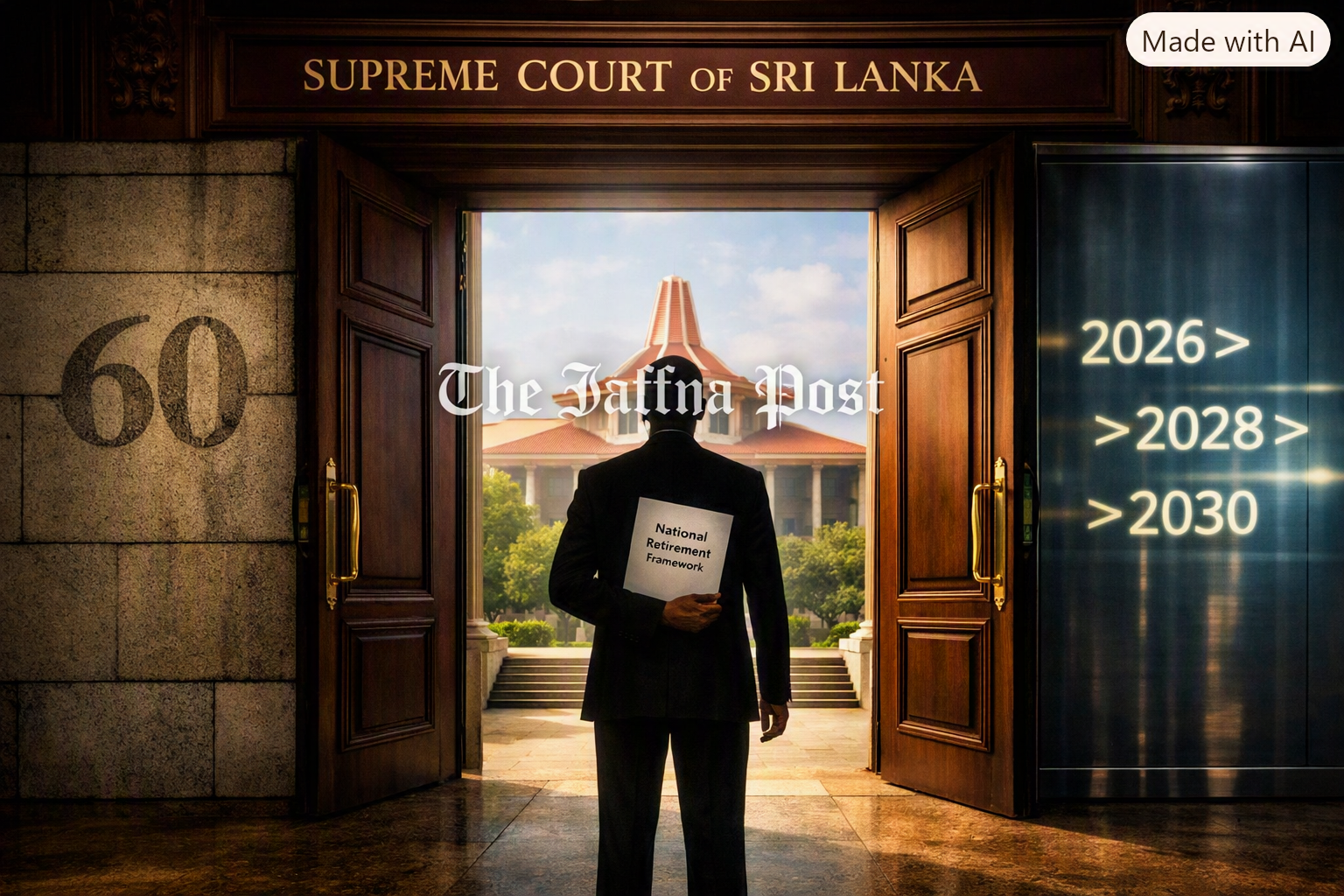

Recent debate in Sri Lanka over proposals to increase the retirement age of judges has largely focused on whether such a move could threaten judicial independence and, consequently, the rule of law.
Far less attention, however, has been given to a more fundamental question: who should determine retirement age, and on what objective basis?
Is retirement age a judicial matter to be determined separately for judges, or is it primarily a matter of public policy that should apply across the public service, with appropriate differences between occupations?
Judicial independence is fundamental. But independence in judicial decision-making should not be confused with administrative policies governing public institutions. Determining the retirement framework for judges does not, in itself, interfere with their independence to decide cases. The real danger arises when administrative powers are used to influence appointments, tenure, decisions or the exercise of judicial authority.
Retirement age is a policy decision
Retirement age should be determined by demographic, economic, social and occupational realities—not simply by tradition or political convenience.
Important considerations include life expectancy and healthy life expectancy, population ageing, workforce requirements, the nature of particular occupations, and the long-term sustainability of pensions and other social-security systems.
As people live longer and remain healthier for longer, many countries have reconsidered traditional retirement ages. Ageing populations and declining birth rates also mean that a smaller working population may increasingly have to support a growing retired population. This places pressure on pensions, healthcare and public finances.
At the same time, different occupations have different demands. Physically demanding or hazardous occupations may require earlier retirement, while professions based largely on accumulated knowledge, experience and judgement may benefit from allowing competent professionals to work longer.
A national retirement framework therefore does not necessarily require an identical retirement age for every profession.
Lessons from the UK
The United Kingdom provides an instructive example. The State Pension age is currently 66 and is rising to 67 between 2026 and 2028, with further increases legislated for later periods.
Importantly, reaching pension age does not necessarily mean that a professional must stop working. Doctors, for example, can continue practising beyond traditional retirement ages provided they remain appropriately registered and meet professional requirements relating to competence and fitness to practise.
The principle is straightforward: age alone does not necessarily determine whether an experienced professional remains capable of contributing to society.
The same principle could apply to other professions, including the judiciary.
What about judges?
Judicial experience and accumulated judgement are valuable national assets. Allowing competent and independent judges to serve longer could, in appropriate circumstances, help retain expertise, reduce case backlogs and improve the efficiency of the justice system.
But any extension of judicial service must be accompanied by strong safeguards for competence, integrity, performance and fitness for office.
At the same time, legitimate concerns exist about career progression for younger professionals. Extending the working lives of senior personnel should not become a means of preventing younger professionals from advancing.
The answer, therefore, may not be simply “retirement” or “no retirement”. What is required is a system that balances experience, competence, institutional renewal and opportunities for younger professionals.
Who should decide?
The central question is not whether the retirement age should be 60, 65, 70 or 75. It is who should determine retirement policy, on what evidence, and according to what principles?
Any change should be based on transparent and objective criteria, including demographic projections, life expectancy, healthy life expectancy, pension sustainability, workforce requirements, occupational characteristics and professional competence.
The process should also be sufficiently independent to prevent retirement and tenure arrangements from becoming political instruments.
The responsibility for establishing such a framework should therefore rest with the appropriate constitutional and public-policy institutions, supported by expert evidence and subject to democratic and legislative scrutiny—not with any single professional group.
Time for an informed debate
Sri Lanka needs a broader, more evidence-based discussion about retirement policy. The issue should not be reduced to a political contest or framed solely around one profession’s interests.
Retirement age is not merely a number written into legislation. It is a public-policy instrument that must evolve with changes in population, longevity, economic circumstances, professional requirements and the needs of society.
The Public Service Commission and other relevant institutions should consider developing a comprehensive national framework for retirement across the public service, with clearly justified occupational variations and appropriate safeguards for professional independence.
The question Sri Lanka should therefore ask is not merely, “When should judges retire?”
It is the more important question of “What retirement policy best serves the nation—and who should be responsible for determining it?”
President AKD, this matter is now over to you.